Almost half of power consumption on TAU campus comes from green energy sources
Strategic plan aims for 100% power from renewable energy
Support Tel Aviv UniversityThe Green Council at Tel Aviv University (TAU) announced that approximately 45% of the campus’ power consumption comes from green energy sources, as part of the implementation of the Univeersity’s strategic plan for climate change and sustainability. This means that nearly half of the power consumed on the TAU campus is no longer based on fossil fuels. This is another significant step that positions TAU at the forefront of sustainability among Israel’s institutions of higher education.
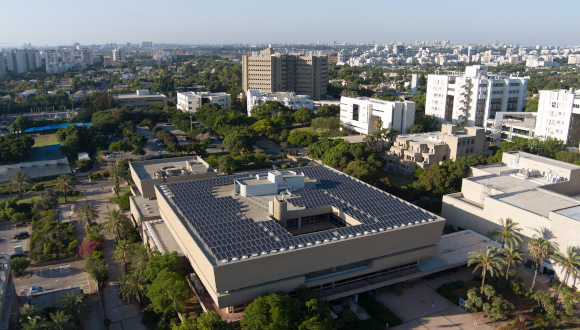
Members of the Green Council explain that TAU annually consumes approximately 75 million kWh of electricity — about 4 million of which originate from 17,000 square meters of solar systems installed on the rooftops of various buildings across campus, including the Dan David, Buchmann-Mehta, Mitchell, Sharett, De Botton, Goldschleger, and Health Professions buildings, and lecture halls of the Gray Faculty of Medical and Health Sciences. A vast solar roofing system will soon be installed on the Smolarz parking lot as well. The remaining green power consumption, totaling about 29 million kWh, is supplied by off-campus solar energy sources.
The Council emphasizes that its plan involves a shift to 100% green power within the next few years, including construction of a large energy storage center on campus. According to the agreement signed with Shikun & Binui Energy, an advanced energy storage facility with a capacity of more than 30 MWh will be built on campus, one of the largest projects of its kind in central Israel and the first in an Israeli academic institution.
The ambitious strategic plan was launched about three years ago by TAU’s Green Council, led by TAU President Professor Ariel Porat and TAU CEO Gadi Frank. Following extensive preparatory work, the Green Council set a series of additional goals, including shifting to sustainable energy, saving energy and water, waste minimization and smart use of resources, sorting waste and reducing transportation emissions, and fostering and preserving flora and fauna. Climate change adaptations such as shading and planting trees is also taking place across the TAU campus.
“Until recently, our use of renewable energy amounted to just a few percent,” said Dr. Judi Lax, Head of Sustainability, Engineering and Maintenance at TAU. “In a short time, we were able to make a dramatic change and reach 45% green power on campus. This is not just an environmental statement: It is a real operational revolution that significantly reduces TAU’s greenhouse gas emissions.
“We see the campus not only as a place for research and teaching, but also as a cradle for meaningful change. Our goal is clear: to turn TAU into a campus that leads the way in rapid, drastic emissions reduction. It is important to understand that these initiatives result from broad collaboration within the university — connecting science, data, operations and field personnel, consultants, management, students, and faculty — as well as a great deal of daily work on the campus itself. Change of this kind only happens when an entire system rallies and works together toward a shared goal.”
“Alongside research and teaching that address the climate-ecological crisis, TAU also sees great importance in the practical implementation of sustainability principles within the campus itself,” saod Professor Marcelo Sternberg, a leader of the program for reducing greenhouse gas emissions on campus and a researcher at the George S. Wise Faculty of Life Sciences. “As a center of knowledge, innovation, and public influence, we have both the opportunity and the responsibility to also lead environmental change through direct action.
“TAU’s rapid rise to 45% renewable energy demonstrates how science, vision, and good management can turn environmental commitment into reality on a significant scale. This is an important message to our students, to Israeli society, and to other institutions both in Israel and worldwide. Meaningful action is both possible and necessary — and the time to act is now.”